Khalil Ladak
10 mins read
10 mins read

Amanda Martyniuk brings more than 10 years of logistics expertise, supported by a background in education and consultative selling. She partners with eCommerce and B2B brands to optimize supply chains, analyze freight and parcel strategies, diversify marketplace operations, and explore new market expansion opportunities, helping businesses enhance efficiency, increase revenue, and maximize profitability.
Have you ever:
If you work in the perishables, cosmetics, and pharmaceutical industry, you will have experienced one of the three. The reason: such industries deal with products that are sensitive to heat, cold, and humidity and degrade when exposed to extreme or fluctuating temperatures.
Treating fulfillment as a generic commodity here has financial consequences, thereby converting fulfillment into a direct liability. Realistically, the compounding cost of cold chain failure (replacements, lost customers, brand damage) far exceeds the cost of integrating proper temperature-controlled fulfillment. So brands looking to scale up their businesses must opt for cold-chain freight logistics in Canada.
In this blog, we will explore the importance of leveraging cold chain and specialty fulfillment as drivers of growth and revenue in the food, supplement, and cosmetics industries.
For businesses dealing in cosmetics, food, and supplements, product integrity plays a critical role. Active ingredients in products such as the delicate fatty acids in fish oil, live cultures in probiotics, or active compounds in natural skincare tend to degrade when subjected to fluctuating heat, moisture, and freeze-and-thaw cycles.
When your products are subjected to these changes during their journey from the warehouse to the consumer, they undergo invisible changes leading to:
The consequences are quite severe. Consumers use the product but without experiencing any tangible benefits, and never reorder it. You lose sales but are unaware of why?
This is precisely why cold chain and specialty fulfillment are mandatory when you ship such products. Such cold chain logistics services ensure your products retain their quality and efficacy.
Many 3PLs talk of offering “climate-controlled warehousing,” but what do they mean by it? Some might say they use 24/7 air-conditioning when transporting your products. Others might say they monitor and maintain specific temperature bands based on the product requirement 24/7. This distinction matters because it directly impacts your product quality.
| Temperature-controlled warehousing | ||
| Storage Type | Temperature Range | Ideal Target Products |
| Ambient Shelf | 64°F to 75°F (18°C to 25°C) | Shelf-stable supplements and standard cosmetics. |
| Cool Storage | 45°F to 60°F (7°C to 15°C) | Natural cosmetics and temperature-sensitive active ingredients. |
| Refrigerated Storage | 33°F to 45°F (0.5°C to 7°C) | Beverages, live probiotics, and sensitive pharmaceutical-grade supplements. |
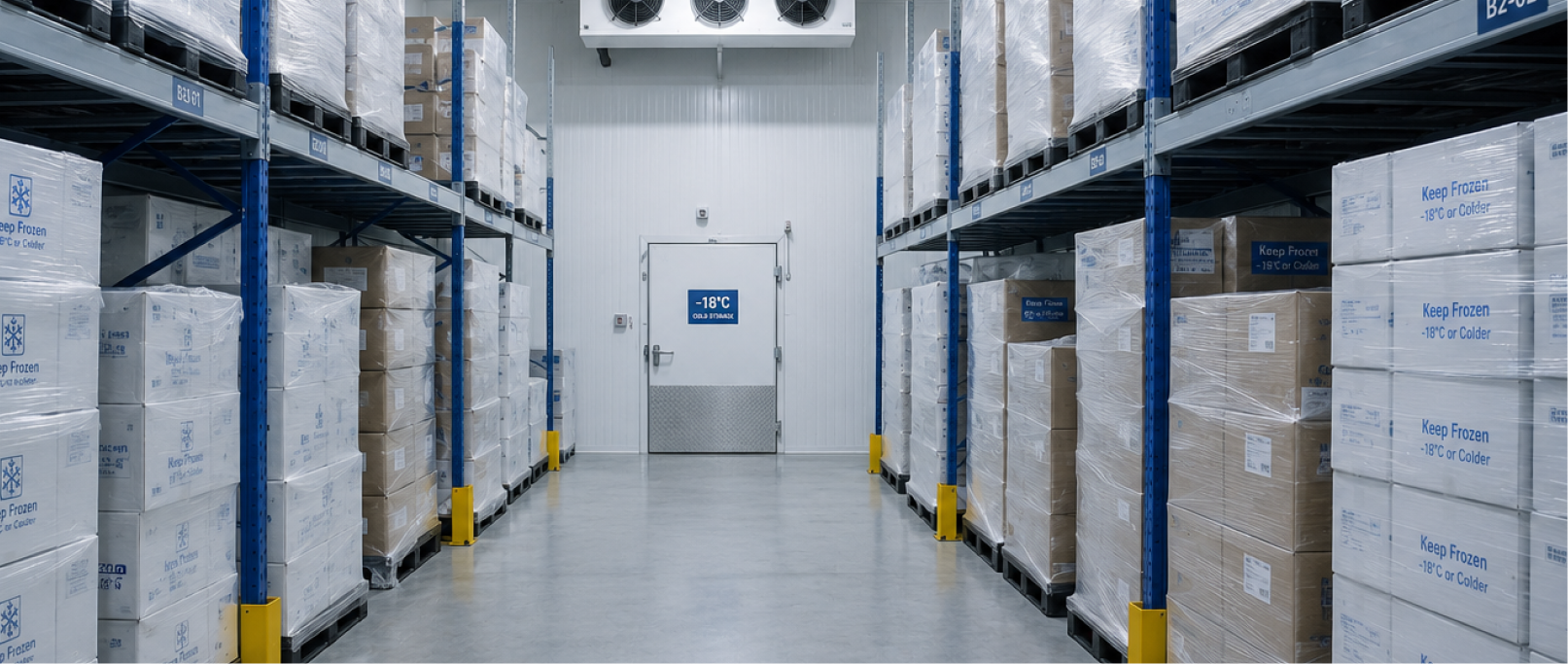
| Frozen Storage | -0.4°F to -13°F (-18°C to -25°C) | Ice cream, frozen meals, and biological samples. |
Here, fulfillment providers manage multiple environmental factors other than temperature. Such warehouse facilities can regulate humidity, air quality, and even air pressure, if required. Such a comprehensive approach works best for climate-sensitive products like wine and certain moisture-sensitive pharmaceutical ingredients and products.
Such warehouses make use of HVAC systems to provide standard storage and works well for sealed supplements, canned goods and other shelf-stable consumer items that don’t need temperature control.
In practice, brands might not stay restricted to only one type of cold chain fulfillment. They might need a combination of cold chain logistics solutions to cater to the differing requirements of the diverse products they deal in.
Any talk of cold chain and specialty fulfillment in Canada is incomplete without addressing the last mile. You might have opted for climate and temperature-controlled warehouses. But if the product has to sit in a delivery vehicle for hours in hot weather, all your efforts to maintain product quality will fail. So how do you address the last-mile heat or cold exposure?
To overcome this challenge, your cold chain fulfillment 3PLs must also account for transit conditions, not just storage. They should provide:
| The Biggest Risks in Cold Chain Fulfillment Temperature excursionsExpired Inventory Last-Mile ExposureSeasonal Weather ExtremesRegulatory Non-ComplianceCross-Border Delays |
When opting for a 3PL offering cold chain logistics services, brands must choose someone who offers:
Such a provider of cold chain freight logistics in Canada allows their partnering eCommerce brands to focus on growth by ensuring a hassle-free cold chain fulfillment.
| Questions To Ask Your 3PL Before Signing: A Cold Chain Checklist Temperature Control & Storage What temperature zones do you operate in? How often is temperature data logged? Can we access it on demand? What's your protocol when a temperature excursion happens? Product-Specific Handling Do you use FEFO (First Expired, First Out) as standard? How do you control allergen cross-contamination? Can you handle products sensitive to light, humidity, or temperature swings? Do you provide traceability records? Cold Chain in Transit How do you validate packaging across different transit times and seasons? Can you support protect-from-freeze shipping? Is the cold chain maintained end-to-end, or does it end at your dock? Certifications & Compliance Which certifications do you hold: HACCP, SQF, or BRC? When was your last audit? Are you Health Canada licensed for NHP storage and distribution? Technology Does your WMS include lot tracking, expiry reporting, and real-time inventory in one place? Value-Added Services Can you handle relabeling? |
While most brands use this term interchangeably, for the fulfillment industry, they do not mean the same thing. They represent different structural capabilities within a 3PL fulfillment center. Recognizing these differences is a critical benchmark you can leverage when evaluating a 3PL service provider for selection.
Cold chain fulfillment focuses only on temperature management. Here, the entire logistics and fulfillment operation, from storage, picking, and packing to transportation and last-mile delivery, is designed around one central idea: ensuring all products are consistently maintained at a defined temperature without interruption throughout the entire journey.
For example, if an eCommerce company needs to maintain a constant temperature of 35°F for a product throughout its journey until delivery to the customer, they must opt for cold-chain fulfillment.
Products that generally require cold-chain fulfillment include beverages, probiotics, and liquid supplements.
The scope of specialty fulfillment is broader. It encompasses many other things along with temperature management, like:
This distinction matters because specialty fulfillment centers are tailored to cater to niche product categories. 3PLs offering specialty fulfillment need to integrate stringent quality control processes to maintain the integrity of the products stored. They must conduct regular temperature monitoring to ensure product quality and compliance with industry regulations.
| Cold Chain Fulfillment vs Specialty Fulfillment: At a Glance | ||
| Capability | Standard Fulfillment | Specialty Fulfillment |
| Inventory rotation | FIFO (First In, First Out)) | FEFO (First Expiry, First Out) |
| Lot tracking | Usually none | Mandatory at every stage |
| Compliance documentation | Not applicable | HACCP, GMP, Health Canada NHP |
| Hazmat handling | Not supported | Built-in for cosmetics/aerosols |
| Kitting | Basic bundling | Lot-controlled, FEFO-enforced assembly |
| Returns | Inspect and restock | Quarantine, document, regulated disposal |
| WMS capability | SKU and quantity | SKU, lot, expiry, zone, compliance records |
| Temperature management | None or basic | Multi-zone, monitored, documented |
The geographical length of Canada makes it important for all 3PL cold chain logistics solution providers to ensure products are kept at the correct temperature and away from climatic fluctuations. To ensure this, eShipper offers 4 core capabilities:
eShipper not only offers the required storage but also ensures that temperature-sensitive products retain their quality while in transit. For eShipper, fulfillment is a product promise, and every stage from storage to the last mile is strategically tailored to help retain product integrity, meet compliance, and build customer trust.
FAQs
Cold chain fulfillment deals with the complete process of storing, handling, and shipping temperature-sensitive products. Here, products are kept in warehouses within the required temperature range so that they retain their properties, quality, and effectiveness. This temperature is maintained without disruption throughout all stages in the product’s journey.
Cold chain fulfillment matters for food, supplement, and cosmetic brands because, in Canada, CFIA regulations require perishable and temperature-sensitive products to be stored and transported properly to prevent spoilage and contamination. Failure is taken as a compliance violation.
Cold chain fulfillment is a broader concept that encompasses storage and delivery of temperature-sensitive products. Processes involved here include:
Temperature-controlled receiving
Controlled storage environments
Temperature-aware pick and pack processes
Monitoring and documentation at every stage
Excursion protocols if the temperature deviates at any point
Temperature-controlled shipping is a part of cold chain fulfillment and only refers to maintaining the required temperature during transit by using insulated packaging, gel packs, or refrigerated carriers.
Here, the liability depends on the contractual agreements that are in place between the 3PL service provider and the brand. Generally speaking, if the break occurs during storage, pick-and-pack, or handover to a carrier, the liability lies with the cold chain service provider. If the break appears when in transit, the liability gets shared between the carrier and the fulfillment provider who has chosen the carrier. If the carrier is chosen by the brand, then the liability rests with the carrier only.
Products that are unable to withstand temperature fluctuations and tend to degrade or lose efficacy, becoming unsafe when exposed to such conditions, ideally need cold chain fulfillment. Some examples include:
Food like ice cream and frozen meals
Supplements like probiotics
Cosmetics such as vitamin C serums, natural skincare products
Cold chain does not refer to any one temperature. It spans a controlled temperature range maintained to preserve specific products. Generally, the cold chain offers 4 storage zones, namely Ambient, Cool, Refrigerated, and Frozen, with each zone maintained at a specific temperature. For the exact Fahrenheit ranges, refer to our temperature breakdown in the Temperature-Controlled Warehousing section.
Yes, cold chain fulfillment supports cross-border shipping, but some complexities need to be dealt with for a successful crossover. Depending on the product category, such goods need to comply with both FDA/USDA requirements on the US side of the border and CFIA regulations on the Canadian side.
To choose the best cold chain fulfillment provider to fulfill your needs, you must evaluate them on the following criteria.
The temperature zone capability
Compliance credentials
Technology, especially if their WMS is automated
Transit coverage offered
Partner with any 3PL that fulfills all of the above-mentioned criteria.