Amanda Martyniuk
12 mins read
9 mins read

With over five years of experience in logistics, fulfillment, and cross-border shipping, Ahmed Sabah develops tailored logistics solutions for businesses of all sizes, from small eCommerce brands to large enterprises. He is recognized for his hands-on support, helping clients streamline operations, reduce costs, and improve efficiency while simplifying complex shipping processes.
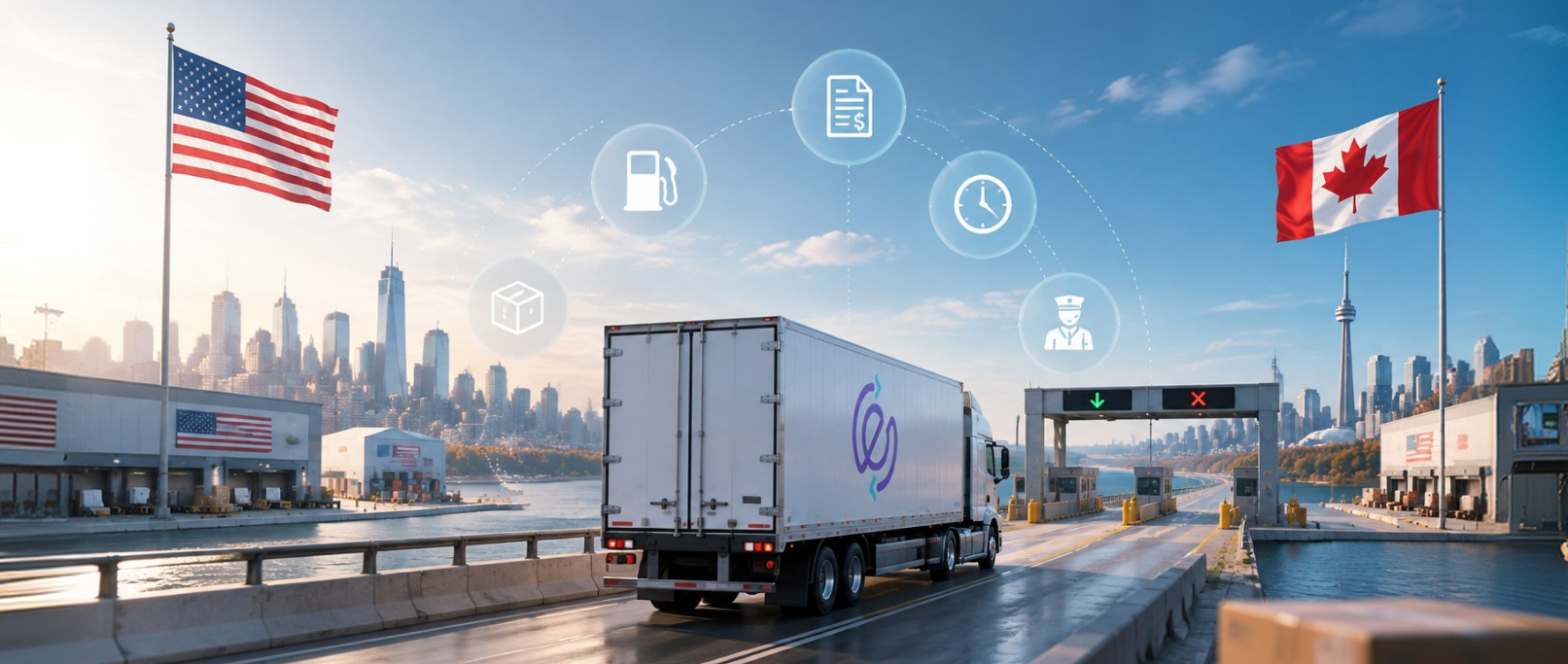
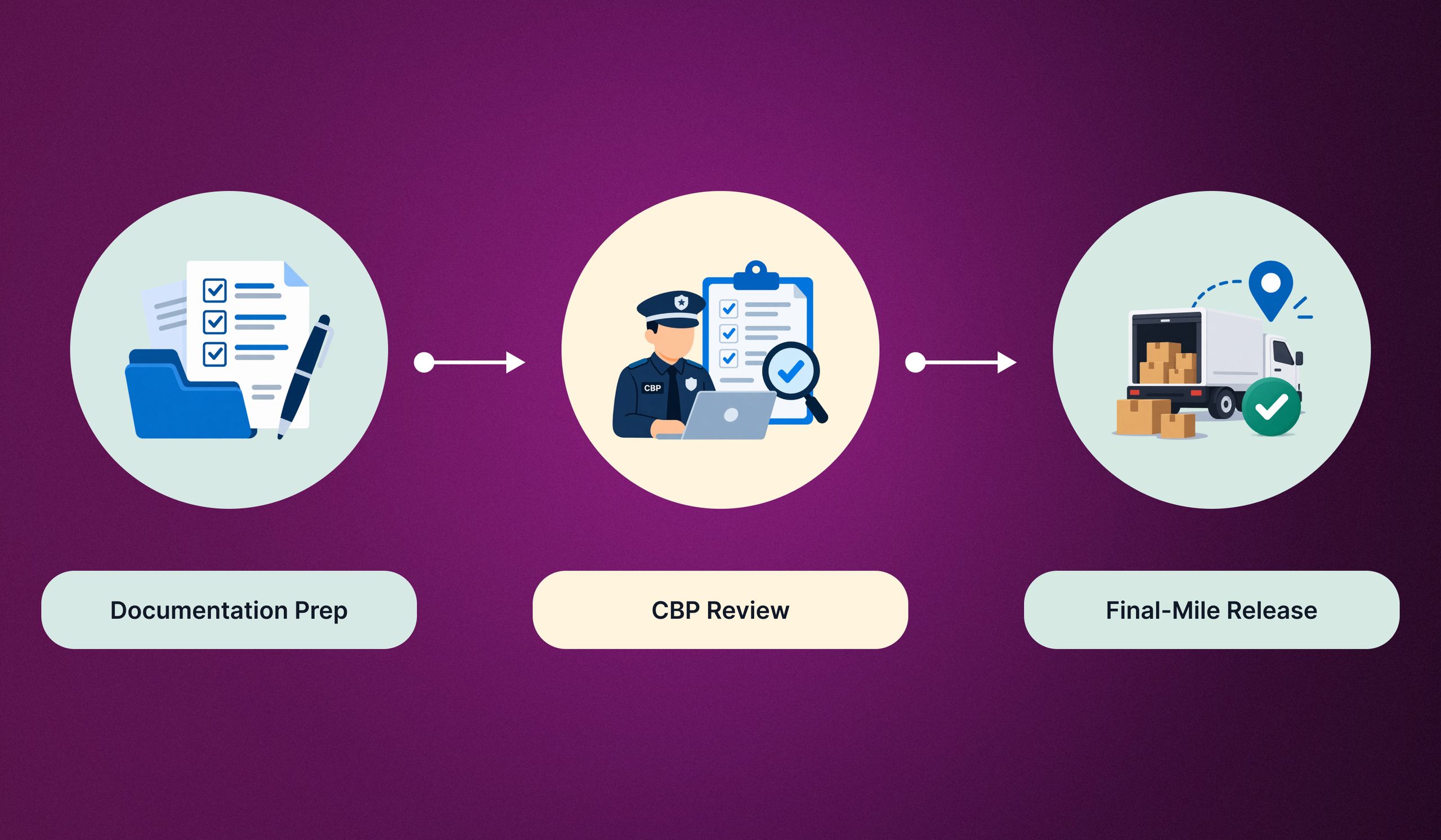
Cross-border shipping from Canada into the US isn't a single handoff. It's three, and each one can stop your freight.
The first happens before anything moves. Your fulfillment partner prepares the paperwork, including a commercial invoice, product description, declared value, verified weight, and dimensions. It's a documentation exercise that affects almost everything that happens later.
The second happens at the border when US Customs reviews what you declared to find:
If the paperwork aligns with US Customs requirements, the shipment clears. If not, the freight stops while somebody sorts it out.
The third includes actual shipping with the released freight, the final leg, and delivery to the US address.
Most brands go all out to improve the third stage while treating the first two as administrative overheads, completely unaware of the costs involved. Interestingly, these costs don't appear on the quote. They arrive much later as chargebacks or hidden shipping fees on invoices referencing shipments that nobody remembers.
Here, we will explore these silent profit killers and how to eliminate their impact.
Before the U.S. repealed the de minimis exemption, most Canadian companies did not seek preferential treatment under CUSMA when exporting to the U.S., even when it applied. The exception resulted in cost savings that made the CUSMA paperwork too much of a hassle. After the exception was revoked, the calculation reversed. Brands that did not recalculate are currently paying duty on shipments that qualify for zero.
But countries cannot get preferential treatment by default. An importer, exporter, or producer must provide documented proof that their products satisfy the rules of origin. Otherwise, they must pay MFN duty rates, which can be substantially higher.
Country of export and country of origin are separate concepts. But most brands confuse them, making it one of the highest contributors to hidden shipping fees.
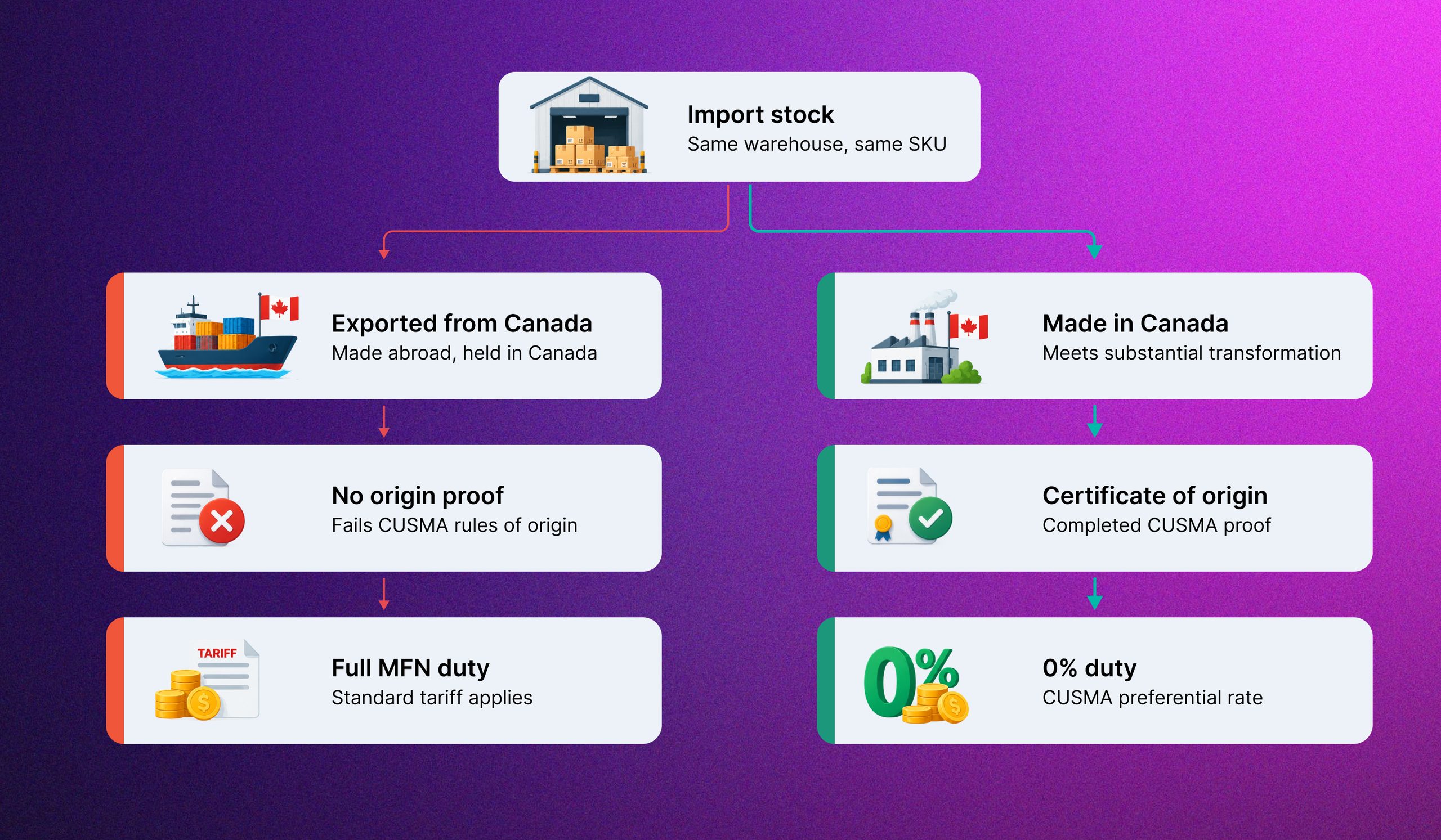
A Canadian brand that imports finished goods from Asia, holds them in a Mississauga warehouse and ships them to U.S. customers is exporting from Canada but it is not exporting Canadian-origin goods.
A certification of origin is a document that helps verify where your product was manufactured, processed, or significantly transformed. These include:
The third point is where most cross-border freight costs originate. Assuming your goods constitute substantial transformation without confirmation can result in higher cross-border hidden shipping fees. Assuming it doesn’t might mean you are paying duty you don't owe.
A blanket period covers multiple shipments of same goods for up to 12 months. This period can be shorter, but it cannot exceed 12 months.
If you repeatedly ship the same SKUs, you can use this blanket certification. Yet for most growing companies, per-shipment certification remains the default because:
Two points worth remembering.
But the CBSA can request verification at any point within that time. A twelve-month blanket period doesn't mean you can discard the document after twelve months.
And the record-keeping obligation is longer than both. Documentation supporting origin should be kept for at least six years after the goods are exported because CBSA might audit them at any time during that period.
If inputs, suppliers, or manufacturing processes change, you must reassess place-of-origin compliance. Applicable blanket certifications must also be updated annually.
There's another obligation that most Canadian exporters are expected to carry. If a Canadian exporter or producer has provided a certification to a U.S. importer and has reason to believe it contains or is based on incorrect information, CUSMA requires them to notify everyone affected promptly. This is a treaty obligation triggered by suspicion, not by an audit finding.
The consequence: a valid claim brings your duty rate to zero. A bad claim brings CBSA penalties under AMPS, plus back-assessed duties with interest. Another hidden cross-border freight cost that businesses tend to ignore.
The rule of origin is keyed to the classification of the goods. Classifying a product incorrectly means you've certified it against the wrong test. Effectively, this increases the chances of your claims failing even when the goods genuinely originate in Canada. Because many CUSMA rules of origin depend on tariff classification, an incorrect HS classification can lead to the wrong origin test being applied. It may undermine an otherwise valid preferential claim.
Also, an HS error invalidates an otherwise legitimate origin claim, and it does so in a way that looks like fraud in an audit, making its impact more damaging.
Classification also determines whether:
Someone has to own the mapping between SKU and HS code, for it accounts for one of the least visible reasons for an increase in hidden shipping fees. Review this mapping when products change to prevent chargebacks in invoices a few months down the line.
Proper pre-arrival filing can reduce preventable delays, but clearance times vary by shipment and border conditions. Without it, or with documentation that doesn't reconcile, the same crossing can take several hours during peak periods. The gap defines the cross-border freight costs that impact four different places, only one of which is visible on the freight invoice.
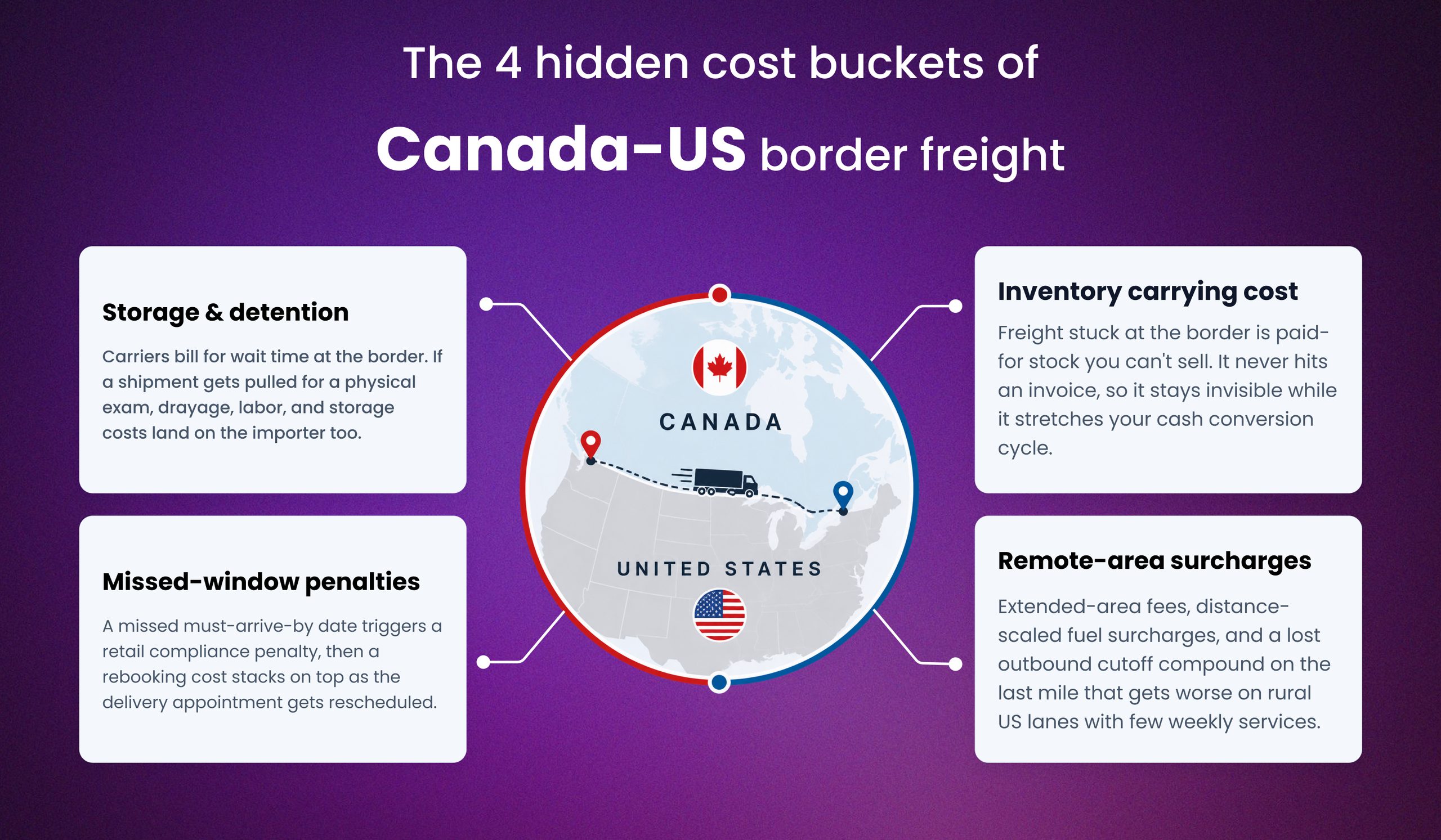
The first hidden cost comes from your carrier. When your truck is held at a border crossing, carriers charge for that waiting time. On an LTL shipment, the mechanism might be different, but the outcome is similar. Your Canada-US cross-border freight sits at a border terminal accruing storage, and everything else on that trailer waits with it.
If CBP escalates from a documentary review to a physical examination, the cost profile changes entirely. Under 19 CFR 4.98, the importer of record is responsible for all costs associated with a customs examination. This means you pay for drayage to the exam facility, labor to unload, and storage while it happens.
CBP uses risk-based targeting and shipment data to identify cargo for further review or examination.
So an importer with a pattern of corrections and amendments accumulates exposure. Also, if CBP pulls a cargo for a contraband enforcement exam, the process can run for two weeks or longer, silently eating into your margins.
This is not invoiced, which is why it stays invisible. Freight sitting at the border is inventory you've already paid for, but you cannot sell it to realize this cost. Every day it sits, your cash conversion cycle extends.
Border transit times are unpredictable. Brands overcome this by holding more safety stock on the US side, or by promising later dates than the average transit would support.
Both erode your margins. One shows up as inventory; the other shows up as lost sales. But neither gets attributed back to the border.
For direct-to-consumer freight, a border delay creates a support ticket and erodes goodwill.
For freight moving into retail distribution, the costs are considerably more because:
This means you pay for the truck holding your freight in the meantime.
The last cost is what happens after release, on the last mile US destination. Carriers apply extended-area or delivery-area surcharges to postal codes outside their standard service footprint. While those charges exist for domestic couriers also, for Canada-US cross-border freight, this cost adds to what the freight has already accrued during its border crossing.
Three things compound costs for remote area last mile deliveries in the US. They are:
Further, release timings shift the entire delivery window. A shipment cleared late in the day misses the outbound cutoff at the destination terminal. On a rural lane, losing a day translates into several days as only two or three services are available in a week. So, missing a daily cutoff can push delivery into the next available service window.
Controlling cross-border cost means intervening at the point the shipment is built. That is where eShipper scores. Let’s see how.
The costs covered in this article don't show up on the freight invoice. They show up in a CBSA verification letter, a B2 adjustment request, or a retroactive assessment with the relevant months/years of interest attached. And by the time they arrive, the shipment that caused them is long gone and the margin it was supposed to protect has already been booked.
This can only be solved by treating the commercial invoice, the weight documentation, and the tariff classification as financial inputs and accurately building them before a shipment moves.

To estimate the true landed cost for cross-border freight, you must start with the applicable duty at the applicable rate after your CUSMA claim. Add the broker fee per entry, the Merchandise Processing Fee, and any duty disbursement percentage your broker charges for fronting the payment. Over and above this, you need to add the extended-area surcharges applicable to last-mile US destinations. Keep a buffer by integrating a realistic allowance for delay to account for the carrier waiting time and inventory sitting time. This will give you the most accurate estimate of the landed cross-border freight costs.
Reclassification is what happens when a carrier or customs authority decides your goods belong under a different code than the one you declared, and subsequently reprices accordingly. On the freight side, LTL carriers assign a class based on density, stowability, and handling. If the pallet they measure doesn’t match what you declared, they reclassify and bill the difference.
For customs, it’s your incorrect HS code. This can move your duty rate and even invalidate an origin claim that was made against the wrong product-specific rule. What makes it expensive is its timing because reclassification frequently surfaces weeks after delivery, as a retroactive adjustment on an invoice you’d already closed.
Yes. Exchange rates can affect both transportation costs and the customs value used to calculate duties when goods are invoiced in a foreign currency. Customs authorities use prescribed exchange-rate rules rather than simply the spot rate chosen by the seller.
A 3PL partner that handles both freight and customs helps consolidate entries. It reduces broker fees and the minimum per-entry MPF you’d otherwise pay repeatedly on small shipments. Further, a 3PL partner that prepares the commercial invoice from the same data that generates the shipping label removes mismatches that can commonly trigger secondary inspections.