
5 mins read

Dubai has positioned itself as a global logistics and trade hub, connecting Asia, Europe, and Africa through advanced infrastructure, strategic geography, and cutting-edge logistics technologies driving logistics optimization in Dubai. As supply chains grow more complex, supply chain visibility in Dubai has become a critical requirement for businesses looking to maintain efficiency, reliability, and customer trust.
From real-time shipment updates to transparent warehouse operations, visibility across the supply chain enables companies to respond faster, reduce disruptions, and make informed decisions. In a market as competitive and fast-moving as the UAE, logistics visibility is no longer optional. It is a core component of modern supply chain management.
Supply chain visibility refers to the ability to track, monitor, and access accurate information across all stages of the supply chain, specifically within the dynamic logistics visibility in Dubai. This includes inventory movement, warehouse operations, transportation status, and last-mile delivery tracking.
In practical terms, logistics visibility in Dubai allows businesses to know where their goods are, what condition they are in, and when they will reach their destination. This level of transparency supports better planning, faster issue resolution, and stronger coordination between supply chain partners.
Dubai’s logistics industry serves a diverse range of industries, including retail, ecommerce, manufacturing, and cross-border trade, highlighting the importance of overcoming supply chain risks in Dubai. High shipment volumes, tight delivery timelines, and international regulations make visibility essential.
Key reasons why visibility matters in the UAE include:
Strong supply chain management in the UAE depends on clear, consistent data flow across all logistics touchpoints.
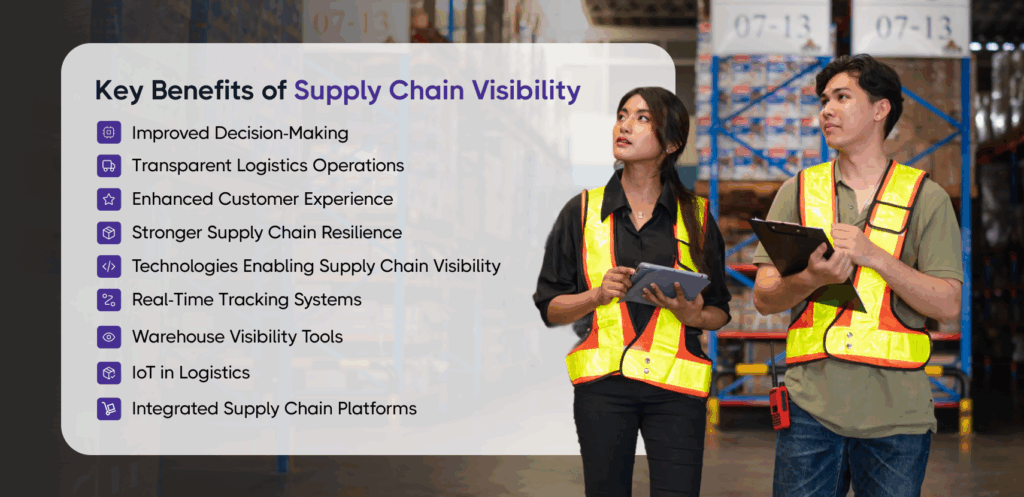
Access to real-time tracking of Dubai logistics data allows businesses to respond proactively to delays, reroute shipments, and optimize supply chain transparency inventory levels.
Visibility creates accountability across carriers, warehouses, and delivery partners, leading to smoother coordination and fewer operational gaps.
Accurate delivery updates and last-mile delivery tracking improve customer confidence and reduce support inquiries.
With better insight into potential disruptions, businesses can plan contingencies and maintain continuity.
These supply chain transparency benefits directly contribute to long-term operational stability and growth.
Dubai’s logistics sector is increasingly driven by digital innovation, with IoT in logistics Dubai and logistics platforms Dubai playing a central role in boosting supply chain visibility.
GPS-enabled tracking platforms provide continuous shipment updates across domestic and international routes.
Warehouse management systems improve inventory accuracy and enable faster order fulfillment.
IoT devices monitor shipment conditions, location, and movement, supporting higher levels of transparency across the supply chain.
Unified logistics platforms connect carriers, warehouses, and tracking data into a single interface, simplifying supply chain oversight. Many businesses in the UAE leverage technology-driven logistics providers, such as eShipper UAE, to access these integrated visibility tools as part of a broader logistics strategy.
Despite technological advancements, many businesses still face challenges with disconnected systems in Dubai logistics that hinder full supply chain visibility.
Common barriers include:
Overcoming these challenges requires both technology adoption and strategic alignment across the supply chain

To achieve stronger end-to-end supply chain visibility in Dubai, businesses should focus on the following areas:
Adopting modern logistics platforms improves access to real-time data and reduces reliance on manual updates.
Clear communication and shared data standards across carriers and warehouses support transparent logistics operations.
Visibility should extend from supplier to final delivery, including warehouse visibility and last-mile delivery tracking.
Analyzing visibility data helps identify inefficiencies and supports ongoing supply chain improvement in the UAE.
As Dubai continues to invest in smart infrastructure and digital trade initiatives, supply chain visibility Dubai will play an even greater role in logistics digital transformation. Automation, predictive analytics, and advanced IoT applications are expected to further enhance transparency and control.
Businesses that prioritize boosting supply chain visibility will be better positioned to adapt to market changes, regulatory requirements, and evolving customer expectations.
Logistics visibility in Dubai has become a defining factor in how efficiently businesses operate within Dubai’s fast-moving logistics landscape. From real-time tracking and warehouse visibility to transparent last-mile delivery operations, end-to-end insight enables stronger control, better planning, and long-term resilience.
As supply chains continue to expand across the GCC and global markets, logistics partners with local expertise, advanced technology, and integrated visibility capabilities play a key role in supporting this shift. In Dubai, providers such as eShipper UAE reflect how visibility-led logistics frameworks can support scalable growth by connecting warehousing, cross-border delivery, customs clearance, and last-mile operations within a single, coordinated ecosystem.
Ultimately, businesses that prioritize visibility across their logistics network are better positioned to adapt, compete, and grow in an increasingly connected global supply chain.
It refers to the ability to track and access real-time information across all stages of the supply chain, from sourcing to final delivery.
Dubai’s role as a global logistics hub requires high levels of transparency to manage complex, fast-moving supply chains effectively.
By adopting digital tracking tools, improving data sharing, and working with technology-enabled logistics partners.
Real-time tracking systems, warehouse management tools, IoT in logistics, and integrated supply chain platforms.
By minimizing delays, preventing errors, and improving inventory planning through accurate data insights.
Reliable data, connected systems, collaborative partners, and consistent tracking processes.
Real-time shipment tracking combined with warehouse inventory updates accessible through a single platform.
It occurs when businesses cannot accurately track shipments, inventory, or delivery status, leading to delays and inefficiencies.
